

Iran’s regime crisis is best modeled as a nonlinear system where coercive cohesion and information control interact with external signaling, chokepoints, and nuclear uncertainty, so incoherent outside support tends to amplify escalation and blowback; effective policy therefore requires coherent signaling and low-salience measures that avoid handing the regime a foreign-ownership narrative while preserving credible deterrence.
The analytic temptation in Iran is to treat regime crisis as a binary switch: either the Islamic Republic is stable or it is about to fall, either outside powers intervene or they abstain, either a movement is “leaderless” therefore doomed or it is “unified” therefore viable. The 1978–79 revolution should have inoculated policy against that framing. The Shah’s state looked institutionally thick, lavishly financed, and heavily securitized, yet it collapsed through a sequence of coordination failures, mis-signaled commitments, and elite defections that were visible in fragments but not integrated into a coherent policy model. The Carter administration did not “lose” Iran in the cartoon sense that history often assigns to presidents. It failed to correctly model the revolution as a contest over legitimacy and coercive cohesion under uncertainty, and it compounded that modeling error with inconsistent signaling and a late, improvisational scramble that satisfied no actor inside Iran. The lesson is not that external powers can deterministically steer Iranian political outcomes. The lesson is that when internal legitimacy breaks, the marginal effect of outside signaling, information infrastructure, and third-party guarantees can be large, but only if the outside actors are internally coherent about objectives, constraints, and second-order effects.
The pre-revolutionary U.S. posture combined strategic dependence on the Shah with an emerging emphasis on human rights that created ambiguity about Washington’s willingness to underwrite repression. Carter’s Tehran toast in 1977, praising Iran as an “island of stability,” broadcast confidence at precisely the moment the Shah’s social contract was fraying, and it reinforced the U.S. tendency to equate state capacity with political resilience (Carter 1977). By late 1978, internal debates between senior officials produced oscillating guidance: push the Shah toward liberalization to relieve pressure, push him toward firmness to restore order, or facilitate a managed transition. Those options are not additive. In a revolutionary environment, mixed external cues can accelerate information cascades because they are interpreted as a proxy for whether the incumbent’s foreign patron will stand by him (Bakken 2004; Moens 1995). When Washington appears uncertain, it can unintentionally supply a focal point for domestic actors to coordinate around the expectation that “the center will not hold,” which raises the payoff to defection and lowers the perceived cost of mobilization.
Intelligence did not deliver a single, decisive warning of imminent regime collapse, and the policy apparatus behaved as if that absence implied safety. Postmortems and documentary records emphasize how difficult it was to infer the Shah’s political trajectory from conventional indicators, and how late-stage reporting competed with institutional priors that privileged the monarchy’s coercive capacity and external backing (Bakken 2004; Balzer 2020). This matters for current policy because the same analytic trap persists: analysts overweight visible kinetic strength and underweight the latent variable that ultimately decides revolutionary outcomes, namely whether coercive institutions will continue to obey orders at scale in the face of broad-based legitimacy loss. The Iranian revolution turned on the paralysis and eventual fragmentation of the coercive apparatus, not on protest size alone, and external actors had limited insight into the internal cohesion of Iran’s security elite until late in the sequence (Bakken 2004; Balzer 2020).
The Carter-era failure was also organizational. Policy objectives were not hierarchically ordered. Was the priority preserving a pro-U.S. monarchy, avoiding mass bloodshed, preventing communist influence, maintaining oil stability, or ensuring continuity of security cooperation? The administration’s actions suggested it wanted all of these simultaneously, and therefore it sent signals that were legible to none. Revolutionary movements exploit that ambiguity because it reduces the credibility of deterrent threats and increases the credibility of “abandonment” narratives. The contemporary analog is that any U.S. or Israeli posture that mixes threats of kinetic action with claims of restraint, while also telegraphing concern for energy markets and regional basing vulnerabilities, can be interpreted by Tehran as bluff, by protesters as either hope or betrayal, and by regional states as a reason to hedge. In 1978–79, Washington’s late-phase outreach to opposition elements did not compensate for years of over-personalizing the relationship through the Shah, because it arrived after beliefs about U.S. reliability had already become path dependent (Moens 1995; Bakken 2004).
Those historical dynamics are directly relevant to the current Iranian crisis, which has escalated into a nationwide confrontation between civilians and the regime’s coercive core. Reporting indicates that protests began in late December 2025 amid economic pressures, expanded into explicitly anti-regime demands, and met a lethal crackdown that is difficult to independently quantify due to communications restrictions (Nakhoul, Hafezi, and Mills 2026; Hafezi et al. 2026). Iranian authorities have implemented near-total internet disruptions, which function both as repression and as a fog-of-war tool that degrades coordination, documentation, and external verification (Roulette and Bryan-Low 2026). The regime’s public framing has emphasized “terrorist operations” directed from outside the country, a standard narrative designed to justify maximal coercion while stigmatizing domestic opponents as foreign proxies (Roulette and Bryan-Low 2026). In parallel, external actors have been pulled into the communications domain through Starlink, which has become a salient vector for both civilian resilience and geopolitical signaling. Reuters reports that SpaceX made Starlink service free for Iranians during the crackdown, and that Iranian countermeasures include jamming and GPS spoofing attempts to degrade service, alongside legal and physical efforts to locate terminals (Roulette and Bryan-Low 2026).
The regional geometry constrains every player. Iran is not just a capital-centric polity. It is a large, rugged state with dense urban nodes on the plateau, minority borderlands with their own political economies, and multiple external arteries that connect domestic unrest to regional security.
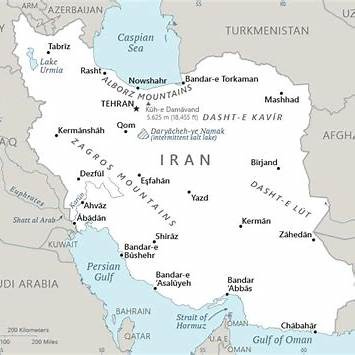
The map above highlights the immediate adjacency set that matters most for scenario analysis: Iraq and the Kurdish corridor to the northwest, Turkey’s border and its own Kurdish security calculus, Afghanistan and Pakistan to the east with trafficking and insurgent spillovers, and the maritime chokepoint at the Strait of Hormuz, which is a systemic risk vector for global energy markets (U.S. Energy Information Administration 2023). The Hormuz factor is not a generic “oil concern.” It is a structural constraint on how far Gulf states will tolerate escalation, because retaliation risk can price itself into insurance markets, shipping, and energy futures faster than diplomacy can respond, and because critical infrastructure in the Gulf is geographically exposed.
The other binding constraint is nuclear uncertainty. Since the June 2025 U.S. and Israeli strikes on Iran’s nuclear facilities, the International Atomic Energy Agency has had limited access to the damaged sites, and key quantities, including the disposition of enriched uranium and stored centrifuges, are not fully verified (Murphy 2026). That uncertainty expands the feasible set for worst-case interpretations. A regime under existential pressure has incentives to create ambiguity about latent capabilities, while external actors have incentives to prevent a clandestine sprint. Even absent actual intent to weaponize, the perception game itself can drive escalation spirals, because each side’s risk tolerance changes when verification is degraded (Murphy 2026). Any wargamed scenario that contemplates coercive pressure must therefore treat nuclear uncertainty as an endogenous escalation amplifier, not a separate “file.”
Within Iran, the decisive question is whether a civilian uprising can convert social mobilization into coercive fracture. Reuters’ analysis emphasizes that the Islamic Republic’s survival historically rests on the cohesion of the Revolutionary Guards, Basij, police, intelligence services, and the patronage networks that bind them to the state’s economic and ideological project (Nakhoul, Hafezi, and Mills 2026). The IRGC is not merely a security organ. It is also an economic actor with entrenched interests, which raises the cost of defection because defection is not just political betrayal; it is asset loss and legal exposure in any successor order (Murphy 2026). That structure biases the system toward repression rather than negotiated transition, especially when leaders believe that compromise risks prosecution or purges.
External actors are already shaping the environment, but largely through signaling and indirect pressure rather than overt force. President Donald Trump has publicly threatened intervention in response to the crackdown and has simultaneously indicated a willingness to hold off based on assurances from Tehran about executions, while U.S. officials have said “all options” remain available (Murphy 2026). That posture creates a triangular signaling problem. To Tehran, “options on the table” is a deterrent threat that must be weighed against U.S. appetite for regional war and basing vulnerability. To protesters, it can read as potential leverage, but also as a risk that the movement will be branded as externally driven. To Gulf partners, it is a contingency that directly implicates their territory and infrastructure. Reuters reports intense diplomacy by Saudi Arabia, Qatar, Oman, and Egypt to avert U.S.-Iran escalation, with emphasis on the downstream security and economic consequences and the risk of retaliation against U.S. facilities in the Gulf (El Dahan and Mills 2026). This is a rational posture for those states: they are structurally exposed to Iranian retaliation and to energy-market shock, and their preferred equilibrium is de-escalation that preserves room for their own economic agendas.
Israel’s position is structurally different. Israel’s security objective set includes constraining Iranian regional power projection and preventing nuclear breakout. In a regime-crisis context, Israel can perceive opportunity in Iranian distraction and in potential degradation of the IRGC’s capacity to fund and direct proxies. At the same time, Israel bears acute risk from escalation dynamics that can widen into multi-front conflict. This creates an ambivalent incentive structure: support pressure on Tehran, but avoid catalyzing a sequence where the regime, fearing collapse, lashes out externally to restore deterrence or unify domestic constituencies.
Russia and China add a different layer: the international-relations constraint. Moscow has positioned itself as a mediator seeking de-escalation, which is consistent with its broader preference for regional stability that preserves its diplomatic relevance while limiting U.S. freedom of action (Reuters 2026). Beijing’s publicly visible interest is non-interference and systemic aversion to norms that legitimize external support for domestic uprisings, alongside a practical interest in energy stability and in the precedent set by commercial satellite constellations contesting state censorship (Roulette and Bryan-Low 2026). Both powers also observe Starlink as an operational and industrial signal about future conflict communications, meaning the Iran case has spillover into great-power competition independent of Iran itself (Roulette and Bryan-Low 2026).
In that environment, “assisting the Iranian people” decomposes into categories of state action that have very different risk profiles and very different causal pathways. A wargaming frame is useful precisely because it forces explicit assumptions: what is the objective function, what are the constraints, what are the adversary’s likely responses, what is the timeline, and what failure modes are unacceptable. The core strategic mistake would be to treat regime change as an on-demand output of external pressure. It is, at most, a contingent outcome that can be made more or less likely at the margins by shaping information flows, elite incentives, and the regime’s perceived payoff from restraint versus massacre. That marginalism matters. In revolutionary contests, small shifts in expectations can reconfigure coordination equilibria, especially when actors are uncertain about whether others will mobilize or defect.
The lowest-escalation option set concentrates on information resilience, documentation, and targeted pressure on coercive units rather than on the Iranian economy as a whole. This includes measures that increase the cost of repression for specific individuals and organizations, coupled with mechanisms that preserve the ability of civilians to communicate and document events. The Starlink episode illustrates both the potential and the limits. Satellite connectivity can blunt the regime’s internet kill-switch strategy, but it also creates a countermeasure race in jamming, spoofing, terminal detection, and legal terror that can impose lethal risk on end users (Roulette and Bryan-Low 2026). From a policy design perspective, the constraint is not only technical. It is human. An external connectivity solution that is available only to a small fraction of users can become a high-risk “tell,” making users targetable, and it can create uneven informational power inside the movement. The wargaming implication is that communications support should be treated as a portfolio problem: redundancy across channels, low signature where possible, and avoidance of single points of failure that invite regime adaptation. Discussing these dynamics is analytically legitimate; providing step-by-step evasion guidance is not. The strategic point is that the communications layer is now a contested battlespace with real escalation spillovers into space policy and great-power observation (Roulette and Bryan-Low 2026).
The next option class is coercive economic and diplomatic pressure calibrated to avoid creating a rally effect or collapsing civilian welfare. This is difficult. Iran’s economy is already heavily sanctioned and structurally stressed, and broad sanctions can unintentionally shift blame outward and empower smuggling networks that are often IRGC-adjacent. Targeted measures aimed at IRGC-linked enterprises and repression enablers can be cleaner in theory, but they require high-quality financial intelligence and multilateral enforcement to avoid symbolic “paper sanctions.” They also interact with Gulf states’ risk tolerance, because an Iran that perceives strangulation can shift into maritime harassment or proxy activation. Gulf states have signaled that they see escalation as a direct threat to their own security and economic priorities, which reduces the political feasibility of aggressive measures that raise retaliation risk (El Dahan and Mills 2026).
A third class involves deterrence and crisis management designed to prevent the regime from externalizing crisis. A regime under mass unrest can try to change the domestic narrative by provoking confrontation with an external enemy, then presenting itself as the defender of the nation. Threats of intervention can inadvertently assist that strategy if they are not credible enough to deter massacre, but are vivid enough to validate the regime’s “foreign plot” claim. This is where critique of current leadership messaging becomes unavoidable on analytic grounds. Public threats that are not backed by a clearly articulated escalation ladder can increase the probability of misperception. Tehran may conclude that escalation is inevitable and therefore preempt, protesters may conclude external rescue is coming and therefore take higher risks, and regional partners may accelerate hedging behavior. The Reuters reporting that regional fears of U.S. attack eased after Trump cited Iranian assurances on executions, while still keeping “options” open, illustrates the instability of this signaling environment (Murphy 2026). In a wargame, unstable signaling is not a neutral variable. It is a driver of adversary belief updating.
The kinetic option space exists, but its first-order risks are unusually high in this case, and the Carter-era analogy is cautionary. External force can weaken a regime’s capacity, but it can also unify factions that would otherwise fracture, and it can produce legitimacy blowback that degrades the very movement it is nominally supporting. In Iran specifically, a kinetic intervention posture must be evaluated against at least six coupled risks: regime retaliation against U.S. and allied forces and infrastructure in the Gulf, maritime disruption at Hormuz with global economic shock, proxy activation across the region, accelerated nuclear breakout incentives under verification uncertainty, internal fragmentation that tips into civil war rather than transition, and the creation of an enduring narrative that the successor order is externally installed. Gulf diplomacy to avert escalation is an explicit recognition of these coupled risks, not a moral posture (El Dahan and Mills 2026). Israel and the United States can model these risks and still decide that certain kinetic actions are justified under certain thresholds, but the analytic point is that “helping protesters” and “conducting strikes” are not automatically aligned objectives. They can be in tension.
A more realistic wargamed objective, if the aim is to improve the probability of a favorable internal outcome while containing regional blowback, is to prioritize conditions that increase the chance of coercive fracture and negotiated exit while reducing the regime’s ability to conduct mass repression at scale. That objective shifts attention to elite incentives and off-ramps. In 1978–79, the Shah’s regime fell when the security apparatus and governing coalition could no longer coordinate on repression as a viable strategy. In contemporary Iran, IRGC and security elites have higher personal downside in any transition because of their economic role and their exposure to international sanctions and potential prosecution, which reduces willingness to defect. The wargaming implication is that any plausible transition scenario likely requires some form of credible commitment mechanism for parts of the coercive apparatus, whether through amnesty structures, exile options, asset freezes paired with conditional relief, or third-party guarantees. Those mechanisms are politically fraught, and they collide with domestic politics in the United States and Israel, but analytically they belong in the scenario set because they address the variable that most directly determines whether repression persists: the expected payoff of continued obedience versus defection.
The Kurdish, borderland, and minority-region dimension is another under-modeled escalation channel. Iran’s Kurdish regions, Baluch areas, and Khuzestan can become both pressure points and fault lines. External actors can be tempted to treat peripheral pressure as a lever, but it carries high civil-war risk. A movement that fractures along ethnic or regional lines is easier for the center to repress piecemeal and harder to translate into national transition. It also creates incentives for neighbors to intervene opportunistically, producing a Syria-like fragmentation dynamic rather than a cohesive transition. Any serious wargame has to treat “civil war risk” not as a generic warning but as a concrete failure mode with identifiable triggers: armed factionalization, external sponsorship competition, breakdown of national administrative continuity, and contested control over energy and transit infrastructure.
Cyber and information warfare are similarly double-edged. The regime’s internet shutdown strategy is not just censorship. It is an operational tool to slow mobilization and to reduce external visibility into state violence. External support that increases transparency can deter some forms of repression by raising expected international costs, but it can also increase the regime’s perception that it is fighting a foreign intelligence operation. The Starlink case again is illustrative: it is watched by U.S. military and intelligence users of Starlink and Starshield, and by China as it develops rival constellations, turning domestic Iranian repression into a testbed for future conflict communications (Roulette and Bryan-Low 2026). That observation pressure can incentivize Iran to escalate countermeasures for demonstration value. From a strategy standpoint, cyber and information measures should be evaluated in the same way as kinetic measures: by likely adversary adaptation, not by first-order capability.
Finally, global economic risk is not peripheral. Iran crisis escalation can transmit through energy prices, shipping insurance, and risk premia, with the Strait of Hormuz as the key choke node in the model (U.S. Energy Information Administration 2023). Those economic pathways feed back into politics: they affect U.S. domestic tolerance for escalation, European crisis preferences, and Gulf partners’ willingness to cooperate. In that sense, the “international relations challenge” is not simply diplomacy. It is coalition economics under time pressure.
If one insists on a wargamed menu of options for leadership, the intellectually honest approach is to frame them as coherent packages with explicit trade-offs rather than as a scatterplot of tactics. One package prioritizes de-escalation and containment: minimize kinetic threats, maximize crisis diplomacy, harden regional defenses, and focus on documentation and targeted human rights pressure. Its advantage is lower probability of regional war; its disadvantage is that it may not change the internal balance fast enough to prevent mass repression. A second package emphasizes coercive leverage without invasion logic: aggressive targeted financial pressure on repression nodes, explicit conditionality for sanctions relief tied to cessation of killings and restoration of communications, and coalition-building with Gulf states to raise the credibility of consequences for retaliation. Its advantage is sharper incentives; its disadvantage is that it can still trigger retaliation and may be undermined by enforcement gaps. A third package is deterrence-forward: credible military signaling designed to prevent mass executions and to deter externalization, paired with clearly articulated limits to avoid open-ended escalation. Its advantage is potential deterrent effect; its disadvantage is that credibility failures can be catastrophic, and credibility requires political willingness to follow through.
Across all packages, the Carter-era lesson is that incoherence is itself a policy choice with predictable consequences. When objectives are not ordered, signaling becomes noisy, and noise in revolutionary contexts accelerates cascades rather than stabilizing them. The current Iran crisis has a communications battlespace that did not exist in 1979, a nuclear uncertainty layer that raises the cost of miscalculation, and a regional economic exposure that makes partners structurally risk-averse. Those are not reasons for paralysis. They are reasons to stop treating “support” as a single variable and start treating it as a system design problem where information, incentives, deterrence, and coalition economics interact.
References
Bakken, Gordon. 2004. “The Iranian Revolution: a U.S. Intelligence Failure?” World Affairs 167 (1): 31–45.
Balzer, John. 2020. “No Islands of Stability: U.S. Policy for Iran, 1977–1979.” Journal of International and Global Studies 11 (2).
Carter, Jimmy. 1977. “The President’s Toast at a State Dinner in Iran.” The American Presidency Project, December 31, 1977.
El Dahan, Maha, and Andrew Mills. 2026. “Four Arab states urged against US-Iran escalation, official says.” Reuters, January 15, 2026.
Hafezi, Parisa, et al. 2026. “Why Iran’s clerical establishment still holds despite unrest.” Reuters, January 2026.
Moens, Alexander. 1995. “The Carter Administration and the Fall of the Shah of Iran.” Journal of Strategic Studies 18 (2): 165–186.
Murphy, Francois. 2026. “Explainer: What is the status of Iran’s main nuclear facilities?” Reuters, January 16, 2026.
Nakhoul, Samia, Parisa Hafezi, and Andrew Mills. 2026. “Iran protests abate after deadly crackdown, Trump says Tehran calls off mass hangings.” Reuters, January 2026.
Roulette, Joey, and Cassell Bryan-Low. 2026. “Musk’s Starlink faces high-profile security test in Iran crackdown.” Reuters, January 16, 2026.
U.S. Energy Information Administration. 2023. “The Strait of Hormuz is the world’s most important oil transit chokepoint.” EIA.
SMA 🏴☠️
The Void